


White Mulberry (Morus alba)
How to identify the plant
Along with lots of birds and animals, you might think of white mulberry as a 20- to 60-foot-tall tree with tasty fruit. But its rampant seeding makes this non-native an invasive pest that squeezes out native species.
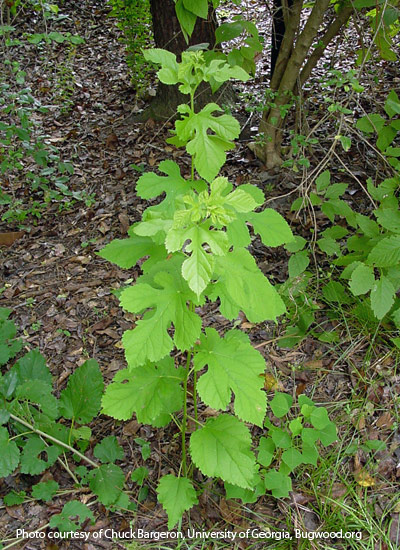
Leaves on young plants are heart shaped with toothed margins, but as the plant matures, they can be deeply lobed or mitten shaped. Unlike the native red mulberry (Morus rubra), the leaves of white mulberry have a soft gloss on top and are smooth on the underside. Pale green spring catkins are followed by red to dark purple blackberry-shaped fruit in early summer.
The root system is shallow and bright yellow to orange. Break a twig and it oozes milky sap. Older bark is furrowed with a slightly orange-gray color. Mature trees tend to break easily in storms.
Where to find white mulberry
Seedlings sprout almost anywhere in North America, in sun or shade, good soil or poor.
How to control white mulberry
Seeds are spread by birds and animals, so remove plants before they set fruit. Pull or hoe out seedlings. Saplings can be dug. Cut down larger plants. Repeat cutting new sprouts or cover the stump with black plastic to deprive the plant of food so it eventually dies. If you need to resort to a chemical solution, look for a nonselective herbicide that can be applied to a cut stump.
You Might Also Like:
How to Get a Stump to Rot Faster
Identifying Weeds in the Garden
5 Ways to Control Weeds Without Pulling Them
The Gardener's Problem Solvers Collection