



Regional Pest Watch: Midwest
Even with hot, humid summers and winter temperatures that get below 0 degrees F, there are lots of pests to battle in Midwest gardens.
Regional expert: Kyle Broderick
Associate Extension Educator, Plant Pathology, University of Nebraska, Lincoln
You Might Also Like:
Regional Garden Pest Roundup
How to Deal with Pests without Pesticides
Permaculture Gardening Basics

Roseslug sawfly Endelomyia aethiops
These ½-inch-long yellow-green caterpillars with an orange head do all the damage and are active from spring to early summer. The adult looks like a fly but is actually a wasp.
What roseslug sawfly eat
This pest eats all kinds of roses (Rosa spp. and hybrids), but it is especially attracted to rambling roses.
Damage to look for
The caterpillar chews and scrapes the upper surface of leaves, creating a windowpane effect. Damage is mostly cosmetic and may diminish flowering, but it won’t kill the rose. Professor Broderick noticed that populations were high in recent years but finds that they tend to peak and wane over time.
Integrated Pest Management (IPM) tips
Handpick caterpillars early in the season or spray them off with a strong stream of water. Beetles, birds, parasitic wasps and small mammals will feed on the roseslug sawfly. Insecticidal soap can help but must come into contact with the larvae to work. Spray both the upper and lower leaf surfaces in early morning or early evening, when cooler temperatures keep the soap from drying too quickly, so more larvae are affected.

Two-spotted spider mite Tetranychus urticae
These tiny arachnids measure 1⁄50 of an inch long and range in color from rusty green to brown, yellow, red or orange with two black spots on their backs. They are most active from spring through summer and produce multiple generations per year.
What it eats
Two-spotted spider mites are a problem for more than 200 plant species.
Damage casused by two-spotted spider mites
Adults and nymphs (juveniles that look like the adults but are smaller) use piercing mouthparts to feed on the undersides of leaves, which causes a stippled or mottled look. As populations rise, plants look bronzed or bleached, leaves and flowers become distorted and these spider relatives produce webbing often found on the undersides of the leaves. They thrive in dry growing conditions and temperatures above 90 degrees F. Healthy plants can withstand some mites, but stressed ones may succumb.
IPM tips
To prevent infestations, use mulch, choose drought-tolerant plants and don’t fertilize during a drought. Spraying with water can help dislodge two-spotted spider mites from foliage.
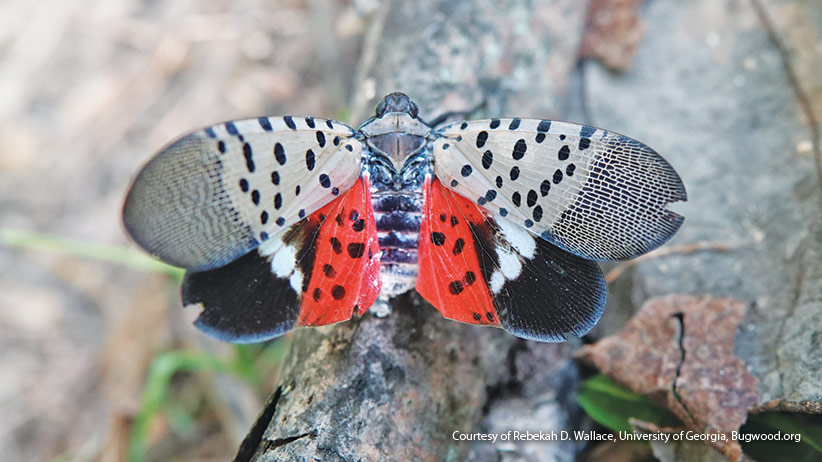
Spotted lanternfly Lycorma delicatula
The 1-inch-long spotted lanternfly adults have brown forewings with black spots and black, white and scarlet hind wings. They’re active from spring through fall and produce one generation of black to red nymphs per year.
What spotted lanternfly eats
First spotted in Pennsylvania in 2014, this colorful, invasive plant hopper is slowly spreading to other states. It feeds on more than 100 plant species, such as grape vines (Vitis spp.), hops (Humulus lupulus), maple (Acer spp. and hybrids) and fruit trees, along with a host of ornamental garden plants.
Damage to look for
Both nymphs and adults use piercing mouthparts to feed, which results in oozing sap, wilting, leaf curling and dieback. They also produce honeydew, which smells bad as it ferments and attracts wasps, ants and bees. The damage doesn’t usually kill plants but causes stress that allows other pests or diseases to move in.
IPM tips
Remove the weedy tree of heaven (Ailanthus altissima), as it is a favorite host plant. In fall, look for and remove the distinctive 1-inch-long egg masses, which look like smeared mud on tree trunks.
You Might Also Like:
See More Ways to Deal with Garden Pests
Problem Solver's Collection
Subscribe to Garden Gate magazine