

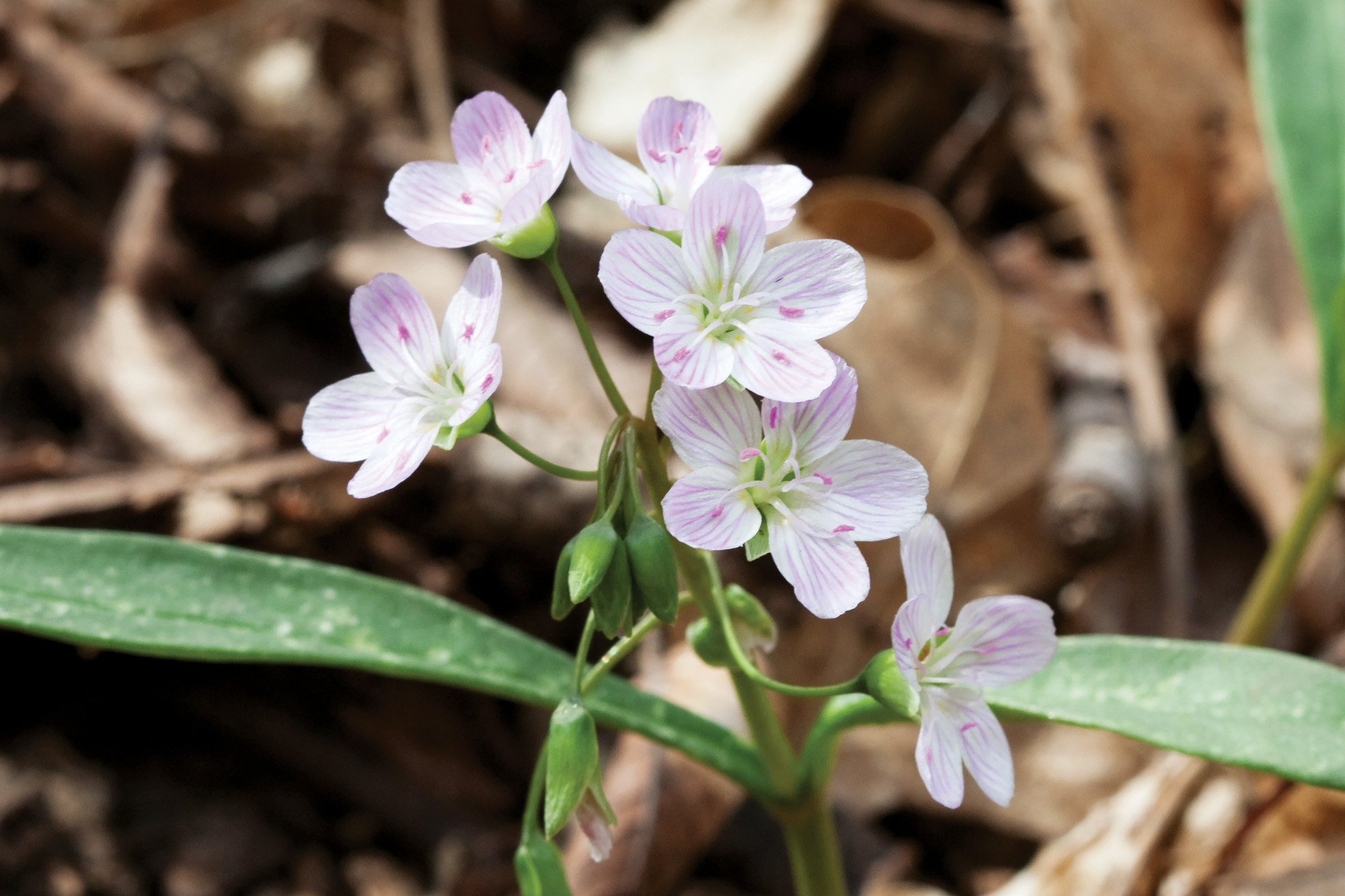
Spring beauty (Claytonia virginica)
Type: Perennial
Blooms: Delicate white-pink petals with pink veining in early spring; plants are ephemeral: the foliage fades away by early summer
Light: Full sun to part shade
Soil: Moist, well-drained
Size: 4 to 12 in. tall, 6 to 9 in. wide
Hardiness Cold hardy in USDA zones 3 to 8
From the wild side: an encounter with spring beauties
I had just sat down under our sugar maple tree (Acer saccharum), hoping to focus on nothing, when a bee buzzed by and focused on me. She was smaller, darker and cuter than a honeybee, and I could’ve sworn I saw pink thighs, but she was definitely checking me out. Was she trying to tell me something? Sure enough, when I stood up, she flew to a tiny hole in the soil I had been sitting on; I didn’t see it until she crawled right to it. She was a mining bee, fresh from her own winter nest, busy building a new one for her babies.
Back then, I had no idea that Nashville had hundreds of species of native bees — each with their own requirements and timing — but I did know that some made nests in soil and that I had finally caught one in the act. So I kept watching. Every time she left the hole, she ignored the sweet violets (Viola sororia), early buttercups (Ranunculus fascicularis) and other blooms in the grass to visit only one species of wildflower: spring beauty.
Native bees are pollen specialists
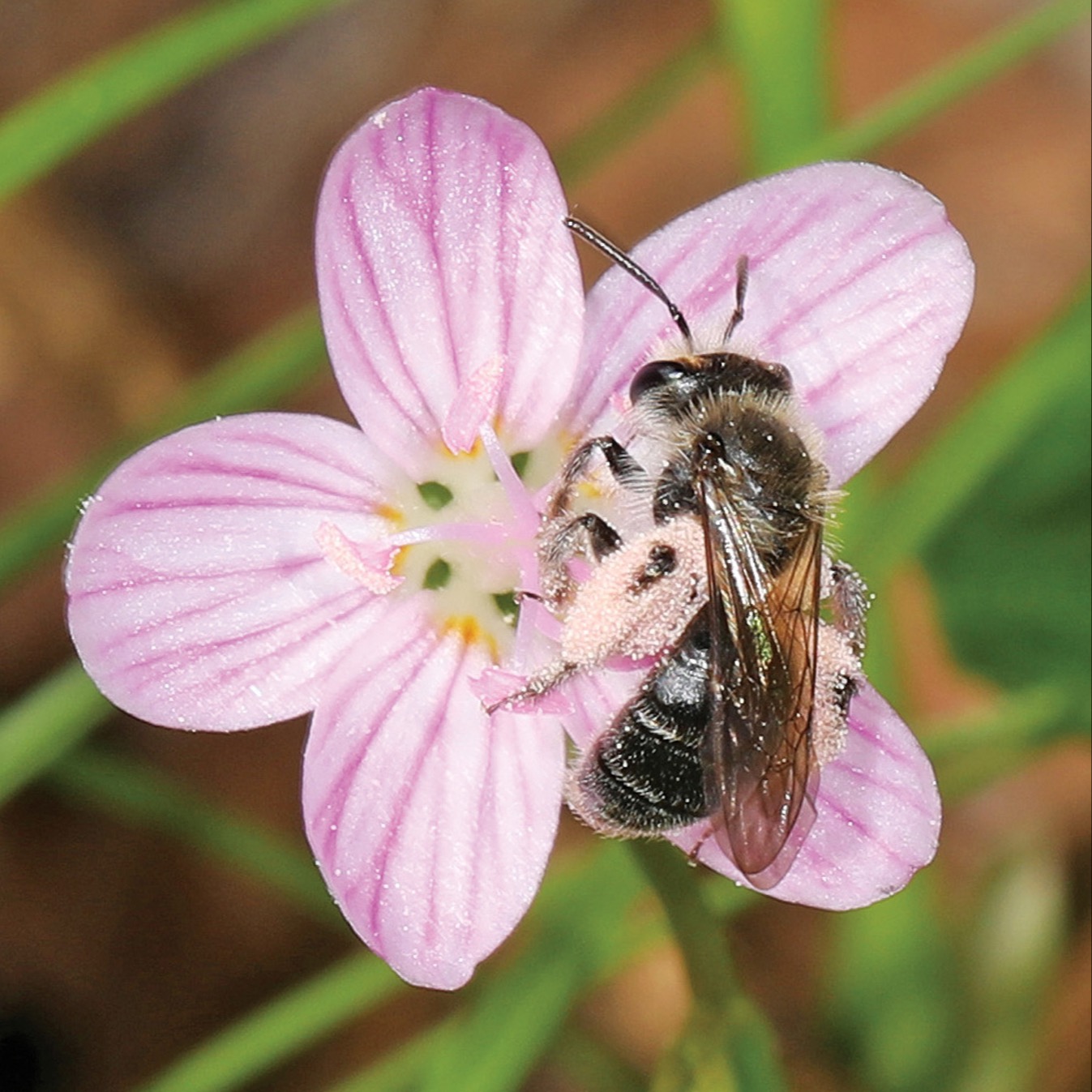
About the size of a dime, spring beauty’s white-pink flower offers nectar and pollen to all sorts of insects. But I had met the one insect who cannot reproduce without it, a spring beauty bee (Andrena erigeniae), a pollen specialist. And get this — the pollen is pink! I was right about those pink saddlebags. If you don’t believe me, check out the close-up view in the photo below.
You Might Also Like:
Grow Eastern Pasque Flower for Early-Season Blooms
Blue Flowers Are Best for Bees
Host Pipevine Swallowtail Butterflies in Your Garden
How the beneficial relationship works
The female spring beauty bee gathers pollen — and only this particular pollen — to provision each of her eggs with a little pink cake. When an egg hatches, the larval bee eats the spring beauty pollen until it pupates. Then next year, when this wildflower blooms again, new adults emerge, ready to make more bees.
Lawns in my neighborhood used to bloom with so many spring beauties, they looked like they’d been sprinkled with snow. But in the 30 years I’ve been watching, a lawn with even a hint of these flowers has become rare. And when the plant disappears, the bees disappear. What if more neighbors knew about this wildflower sleeping in our seed bank? What if they knew about the charismatic little bee who depends on this flower, and that there are many other specialist bees as well?
You Might Also Like:
You've Heard of No-Mow May, Try a Bee Lawn!
Pollinator-Garden Plant Pairings for Every Season
Wildlife-Friendly Garden Plans
Change garden practices to support pollinator populations
I know from personal experience that falling in love with just one native bee, butterfly or bird can change everything, change us. It’s why I’ve shrunk the lawn, quit herbicides and pesticides, weeded invasives, planted natives and written a book.
I also know that we can’t fall in love with what we haven’t met, which could be, by the way, the best reason to take breaks under a sugar maple even when trying to focus on nothing. You never know who might buzz by.
Keep an eye out for native bees
Want to meet a spring beauty bee? Find the flowers and some sun between 10 a.m. and 2 p.m. Try when the day isn’t breezy, so the only movement is a bee. If you see a flower tip under the bulk of a visitor, it’s not a spring beauty bee — it doesn’t weigh enough to bend a stem. If you see a small black bee with sparse white whiskers and saddlebags loaded with pale pink pollen, there she is — the real beauty of spring.
Plant sources
- Prairie Moon Nursery, 866-417-8156
- Izel Native Plants, 410-989-3721
Joanna, author of This Is How a Robin Drinks: Essays on Urban Nature, writes about everyday wonders in everyday habitat loss on Instagram @jo_brichetto and at SidewalkNature.com.