



Discover a garden oasis in British Columbia
Perched on a hill, Nadine and Ted Staunton’s home and back deck offer a perfect view. Not only do they look over their own garden, but they can also see the woods at the edge of their property, the nearby Fraser River and even the distant Coast Mountains. Sometimes they hear coyotes yipping, watch bald eagles soaring overhead and catch glimpses of black bears lumbering through the trees.
Taming the slope: 20-year evolution of a Zone 8 garden
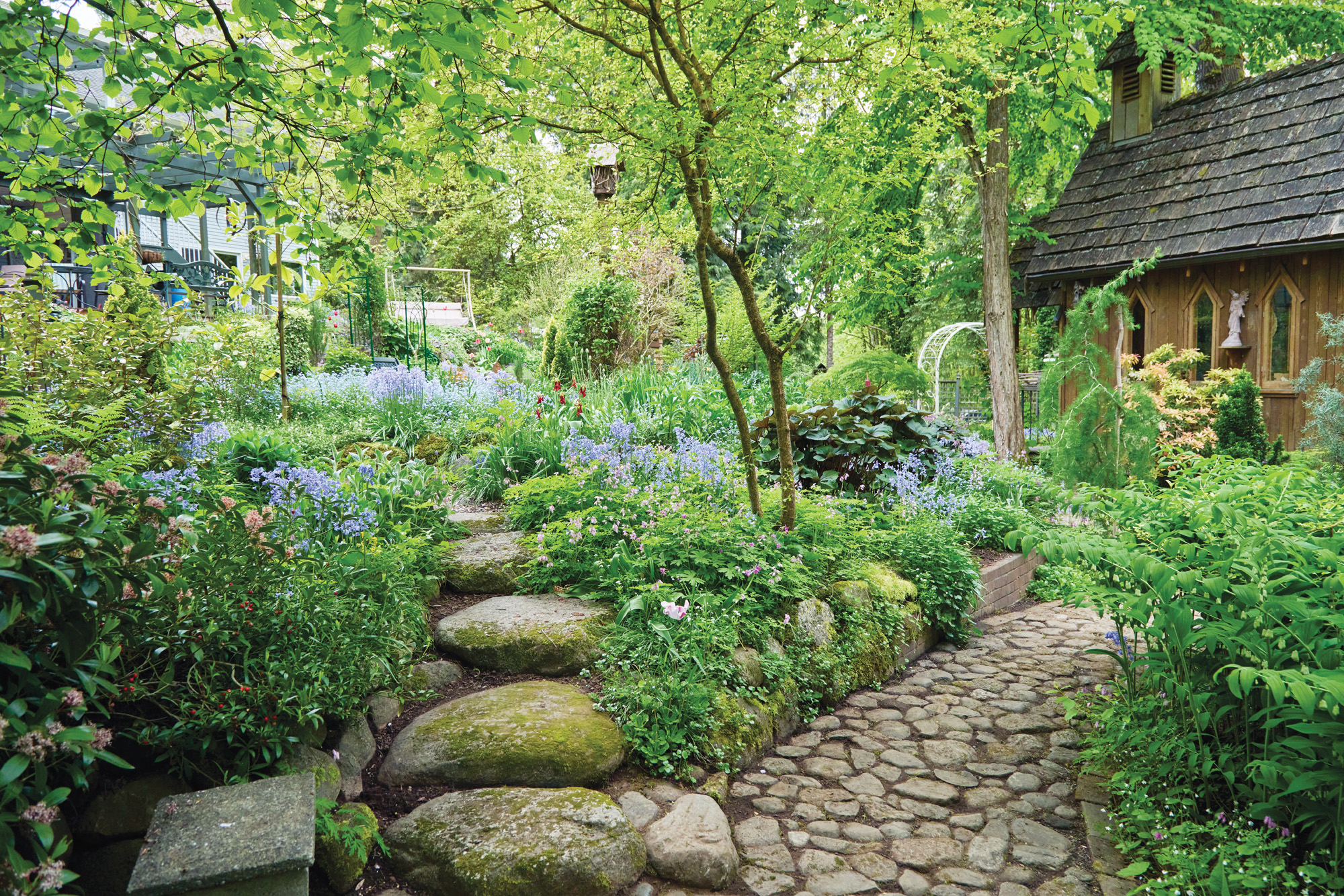
In a little more than 20 years, they’ve created an engaging landscape on their USDA zone 8, sloping Surrey, British Columbia, backyard. It wasn’t easy to accomplish, but now stone paths meander through terraces of trees, shrubs and perennial flowers interspersed with mossy stones and wooden arbors, pergolas and even a custom-built chapel tucked into the woods. Let’s take a tour of this lovely garden and learn some of the tips that the Stauntons have gathered while establishing it.
You Might Also Like:
Talk & Tour: Beautiful Hillside Garden
Garden Planting for Around a Gazebo
Subscribe to Garden Gate Magazine
The garden’s beginning
When Nadine and Ted were ready to build a home on the L-shaped 1-acre lot in 1989, they had to use a bulldozer to clear scrub alder (Alnus spp.) and maple (Acer spp.) trees that had been allowed to take over.
A house on a hill has the benefit of great views and cooling breezes, but a property with a steep slope also presents challenges. For the first several years that they lived there, they tried to grow grass on the slope, but it was difficult to maintain, as you can imagine. And Nadine says, “You can’t play croquet on a sloping lawn.”
A labor of love
Furthermore, a ravine runs along the side and across the back of the property, and had apparently been a dumping site for many years: It was filled with garbage, including an old iron bathtub and a car chassis. Nadine says, “People used to just tip things over the edge instead of taking them to the dump.” Ted and Nadine had their work cut out for them if they wanted to enjoy, instead of simply tolerate or manage, their backyard.
Creating terraces to manage the slope
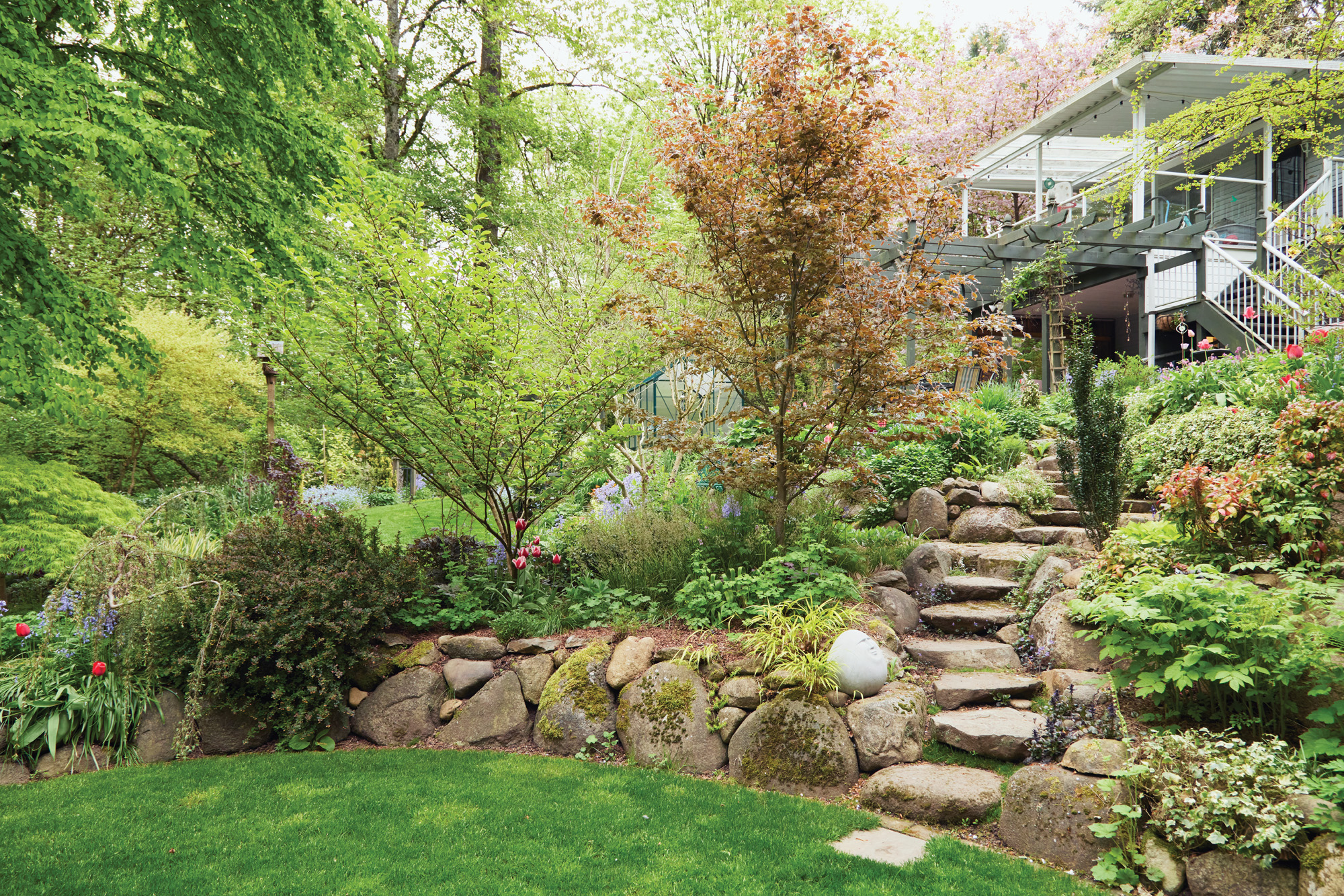
Finally, Ted was tired of sliding off the tractor seat while doing lawn maintenance, so he decided to use terracing to level off the steepest area close to the house. He began by creating a few beds held in by landscape timbers, which was the common method at that time. Nadine says, “When we started, Ted laid out the outline of the flower bed with a garden hose, and I thought, ‘That’s far too big. I’ll never be able to look after it.’ But since then it’s grown exponentially!”
Over the years, the timbers deteriorated, and when they required replacing, Ted realized that he and Nadine already had plenty of raw materials in the stone that they regularly unearthed in the soil and at the bottom of the ravine. So he rebuilt the walls, and eventually made the stairs in the backyard.
Stone walls, pathways and more
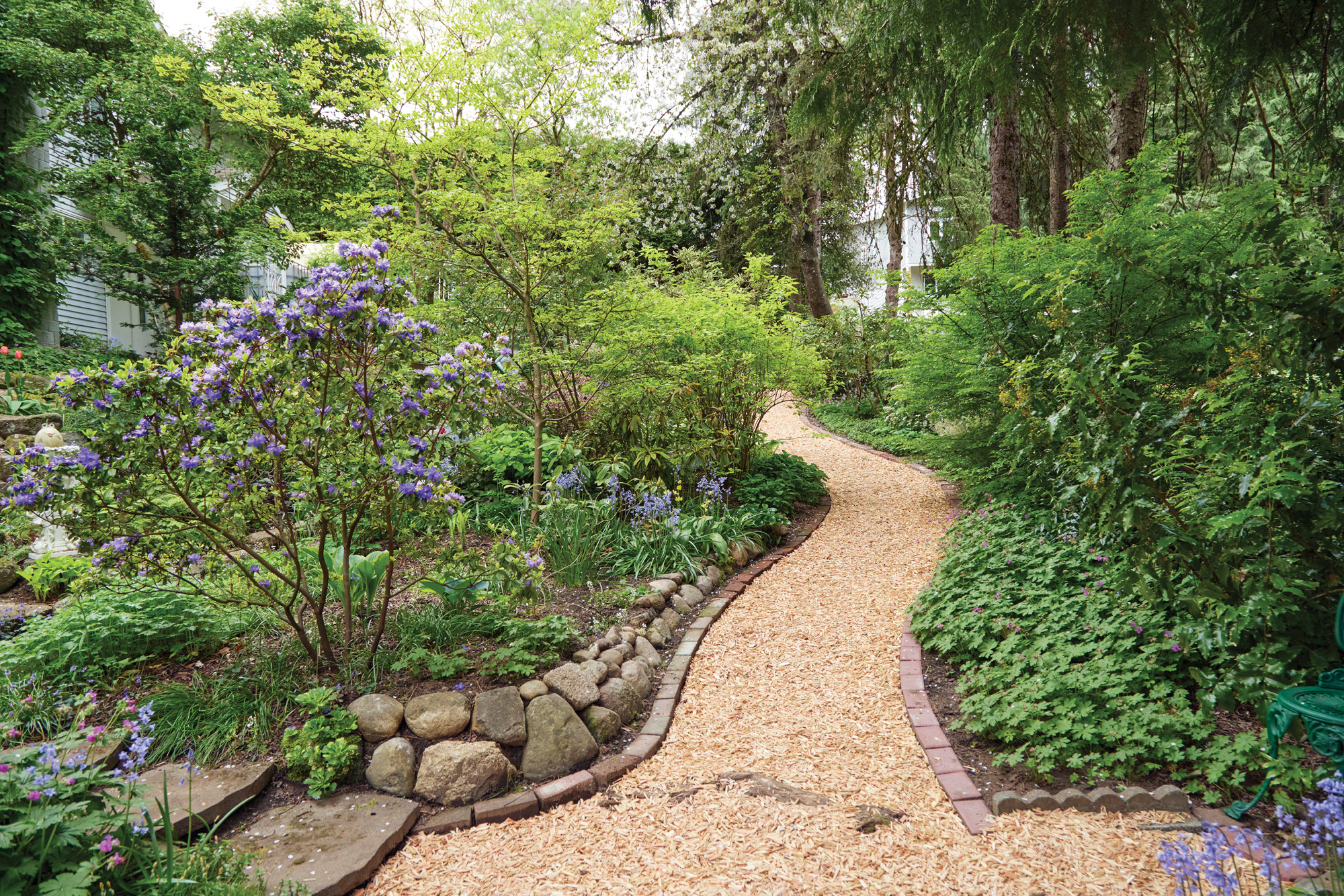
Those first stone walls near the house launched a decades-long project of more pathways, staircases and walls that wind their way through densely planted beds and trees, and now there are only a few small areas of lawn left. Ted, a graphic artist by profession, has an affinity for curving lines and has created a layout that feels intimate yet celebrates expansive views. Keep reading to learn more about the Stauntons’ adventures in stonework.
You Might Also Like:
Timeless European Garden Design Ideas to Try
Meet Epimedium: A Classic Shade Garden Perennial
The Problem-Solving Garden Book Collection
Working with stone in the garden
Once he gained some stone-working skills, there seemed no end to the inspiration (and supply!). Ted says, “I kept getting annoyed walking sideways on the property, so I’d try flattening this area, and then another. And pathways just kept presenting themselves.”
Ted’s tips for moving stone
Ted has hauled thousands of stones, and with a clicker keeps track of every one that he brings from the ravine that’s larger than a loaf of bread. So far, the number is higher than 3,000. For smaller stones, he walks the wheelbarrow down the switchback paths he built into the side of the ravine, fills it and pulls it backward to the top, bumping it along slowly.
A come-along winch is a game-changer
He employs the laws of physics and simple tools to lift and place the ones too large to carry. A come-along winch has been an invaluable resource: He’s able to chain one end of the cable to a tree and the other to the large rock to be moved, then ratchets the lever to draw the stone up the hill. Then he moves farther up the hill, hooks it up to another tree and continues. Still not an easy proposition!
An affinity for stone
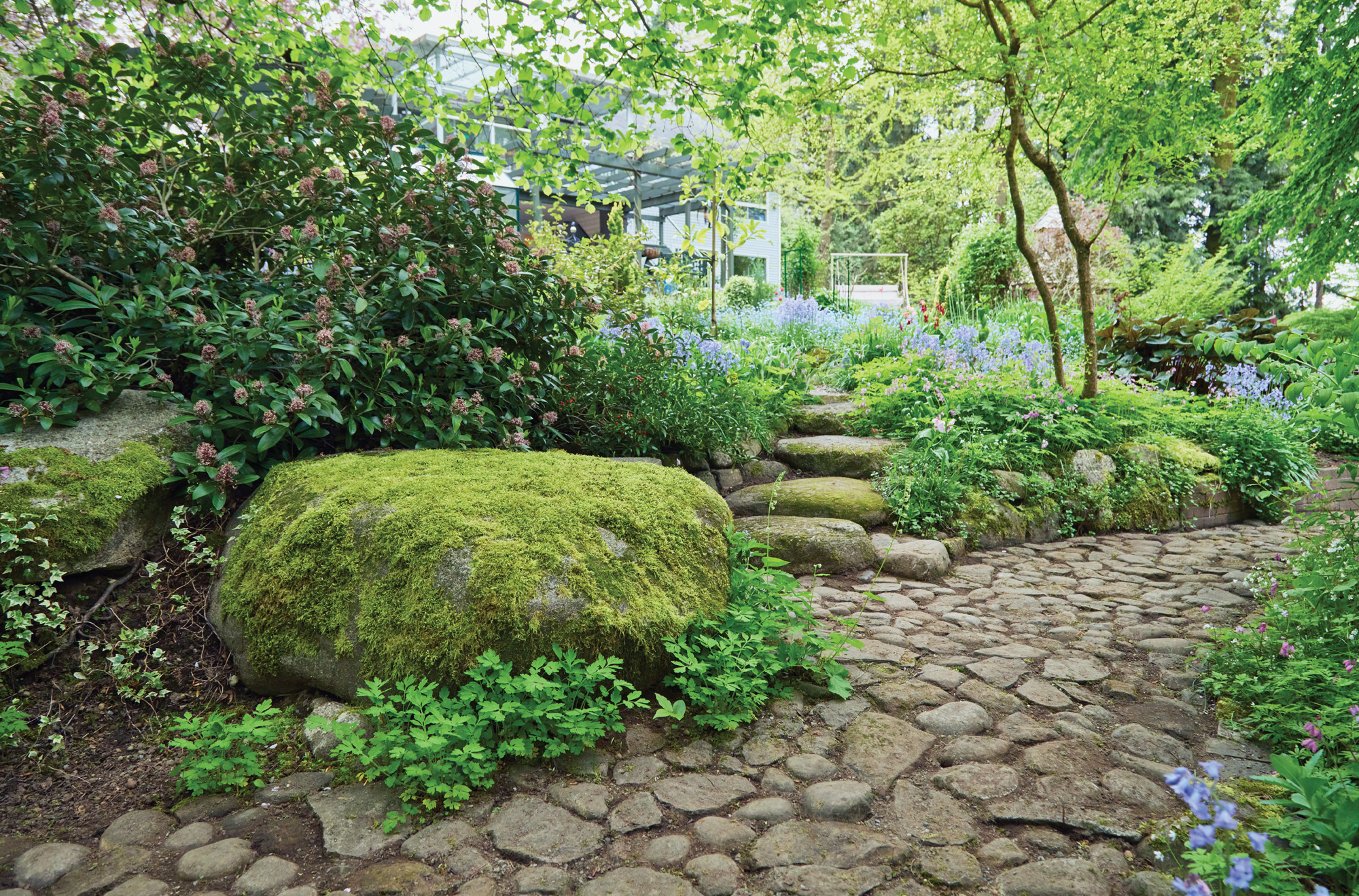
The name Staunton has its origins in Old English, and was given to someone who lived near stony ground. It seems fitting as Ted has developed a keen eye not only for the best way to move each rock but also how to display and honor it. When he sees a stone with unusual characteristics, such as veining, speckling or a blue color, he places it next to a path where it’ll be seen. And every specimen’s unique shape inspires how it’s placed or how the path is built.
He likens building a wall or path to putting a puzzle together, considering color, texture and the different faces. See how perfectly the combination of different sizes and shapes of stones in the photo above fit together? Nadine says, “If I accidentally dislodge one, I have to get him to put it back,” because it’s such a precise art.
Moss: a shady benefit
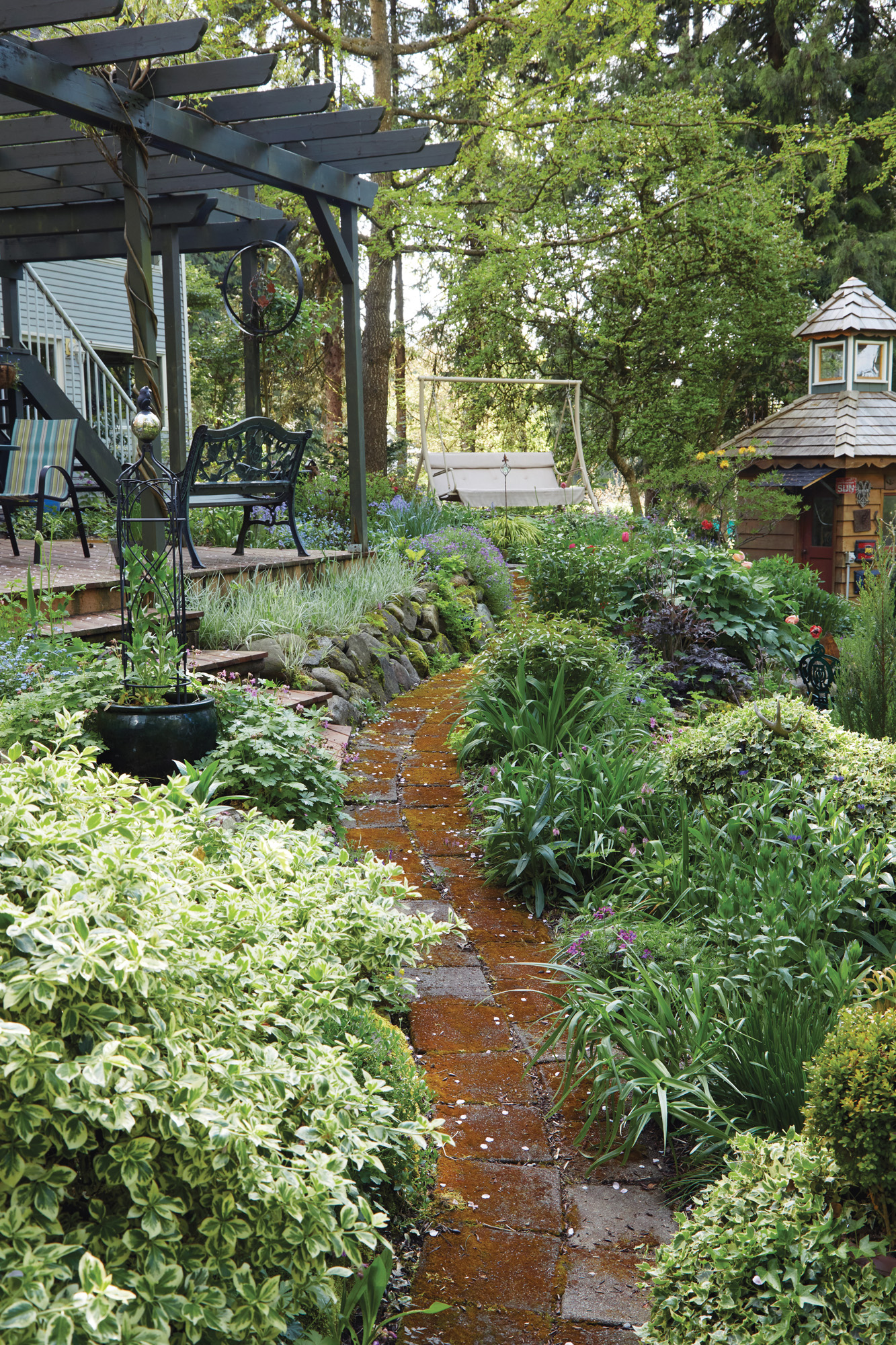
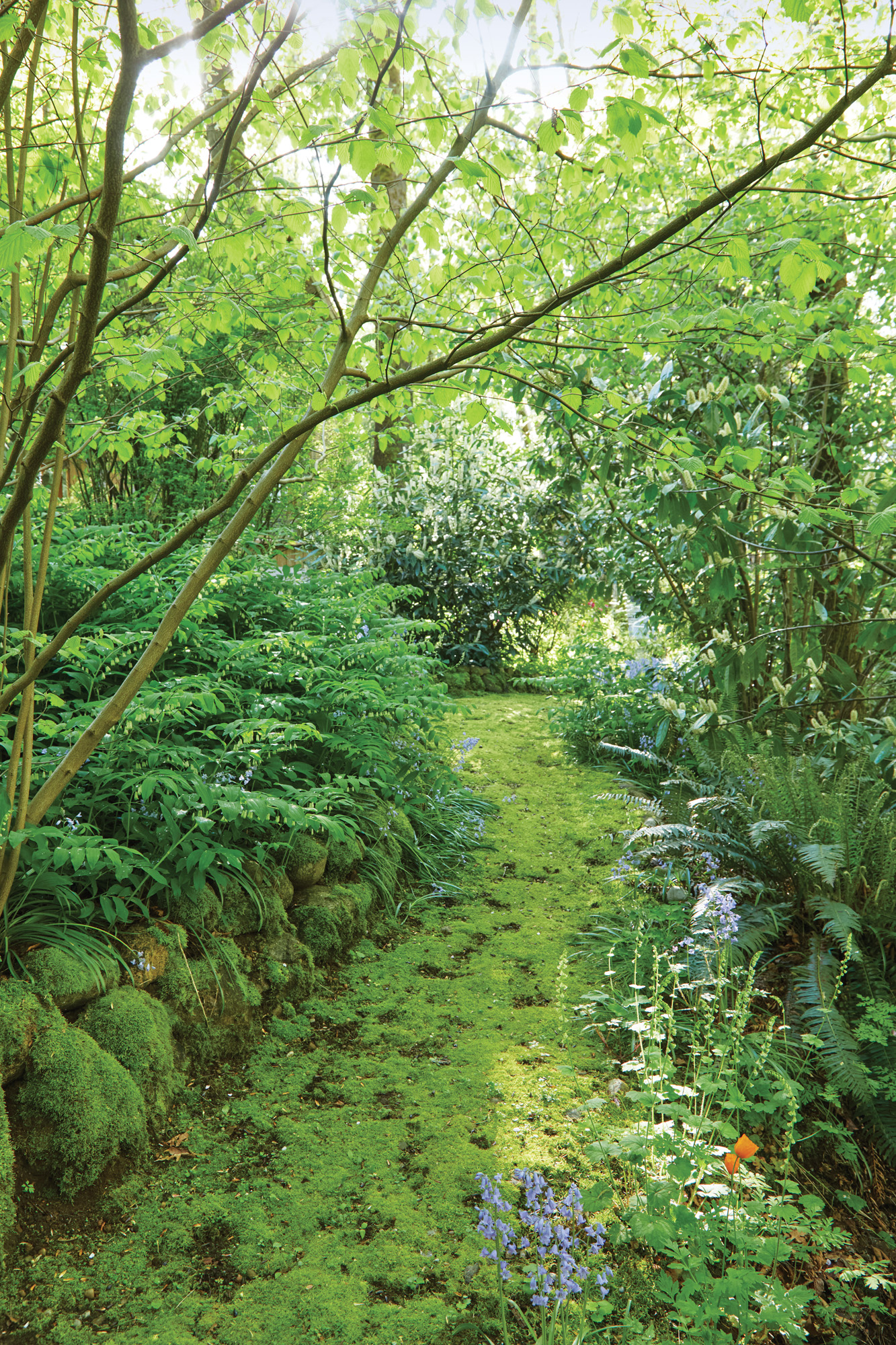
Moss grows happily here, and the soft spongy pathway and beautiful stone faces are typical in this shady north-facing slope. However, they don’t mind its vigorous growth when in the lawn, because it remains green even when the turf turns brown.
Related Articles:
Talk & Tour: A Love Affair with Texture, Stone & Water
Marvelous Moss Garden
Watch Our Garden Videos on YouTube
Unique hardscaping
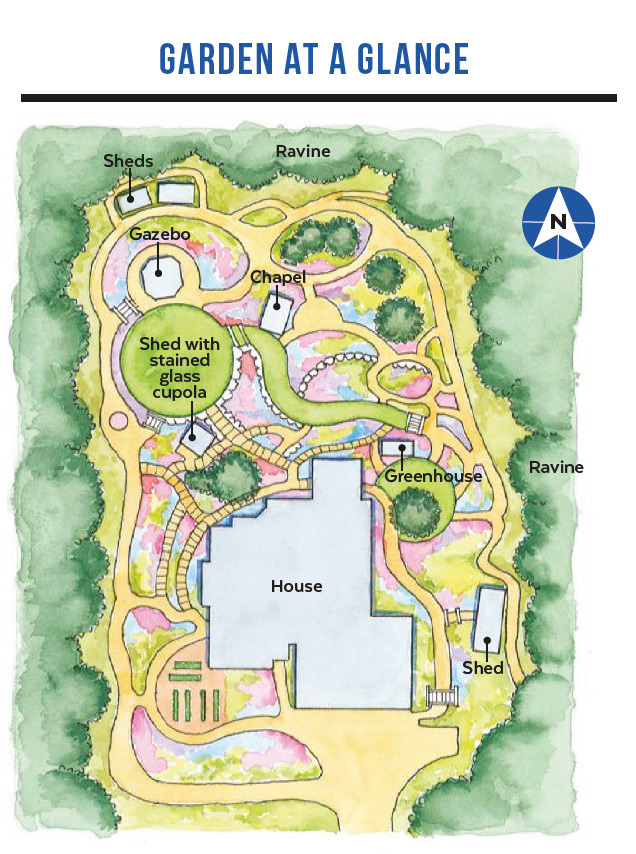
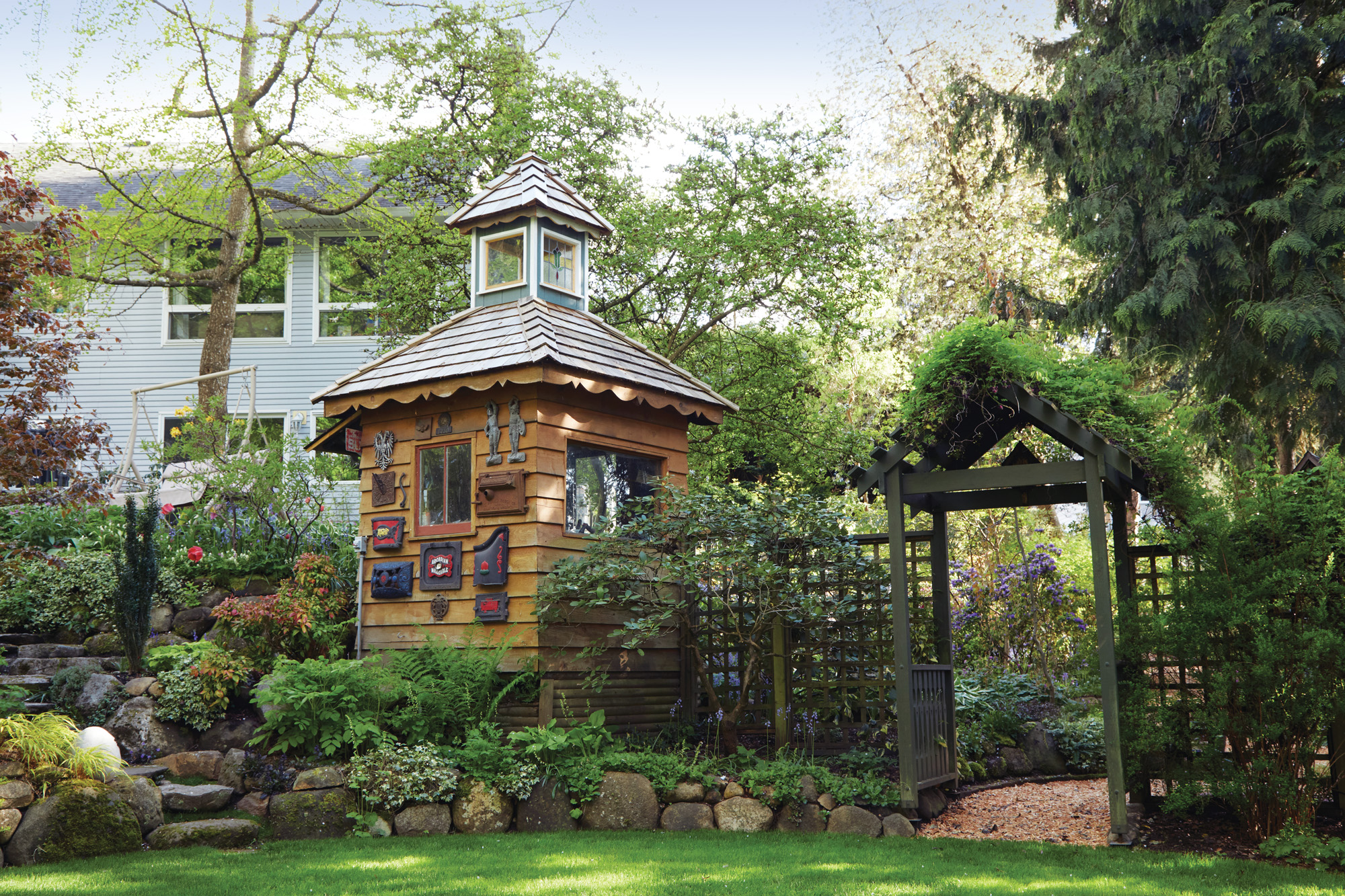
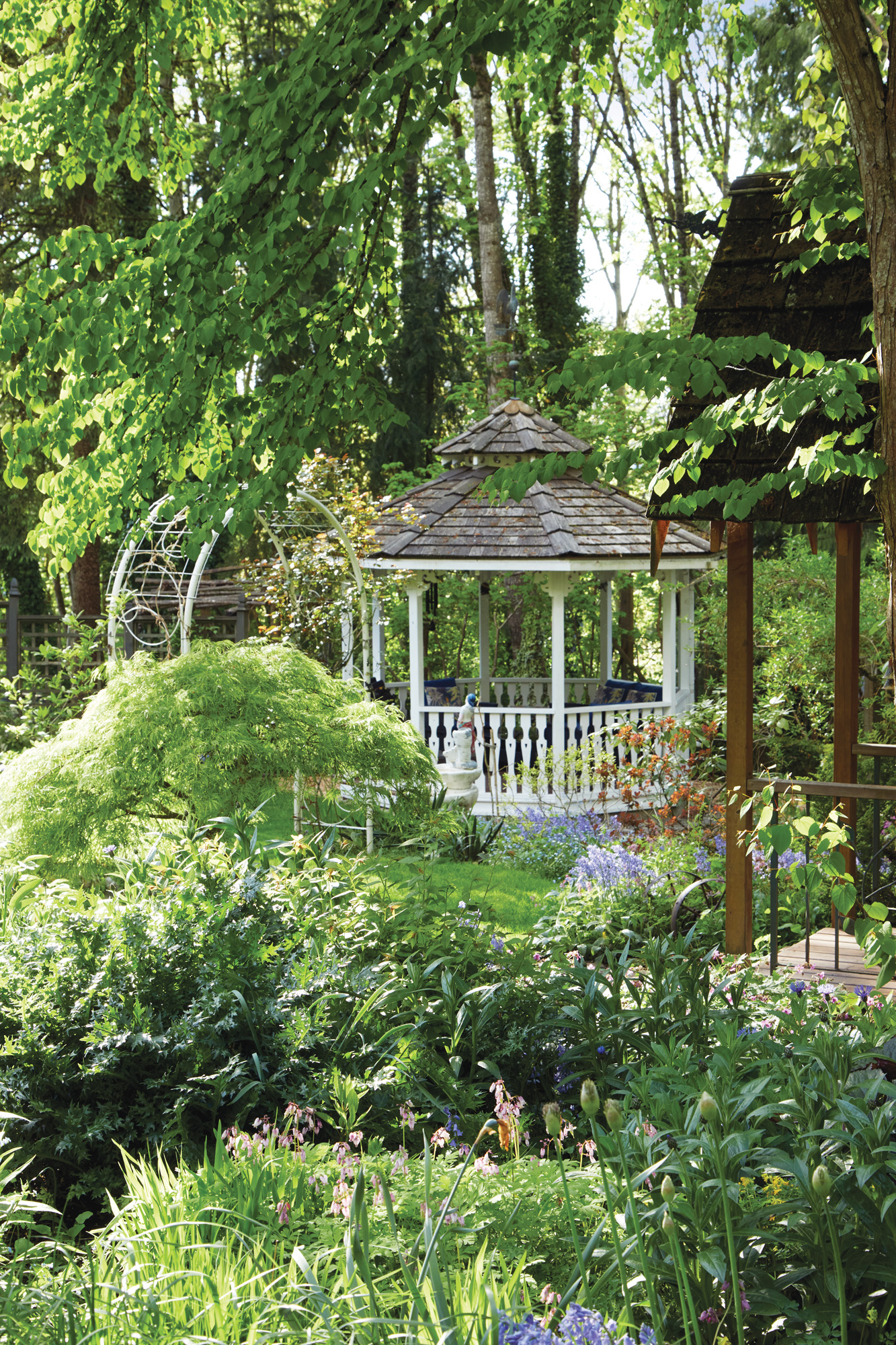
Stonework isn’t the only hardscaping handiwork on display in this garden. Arbors, a pergola, a shed, a greenhouse and the miniature Gothic-inspired chapel provide visual interest and utility. Placement and construction are all done with a view of the garden in mind. Picture windows in the shed face the back of the property and look over the hillside. And their pergola is in the perfect spot to catch a cooling breeze on a hot summer day.
An affinity for upcycling
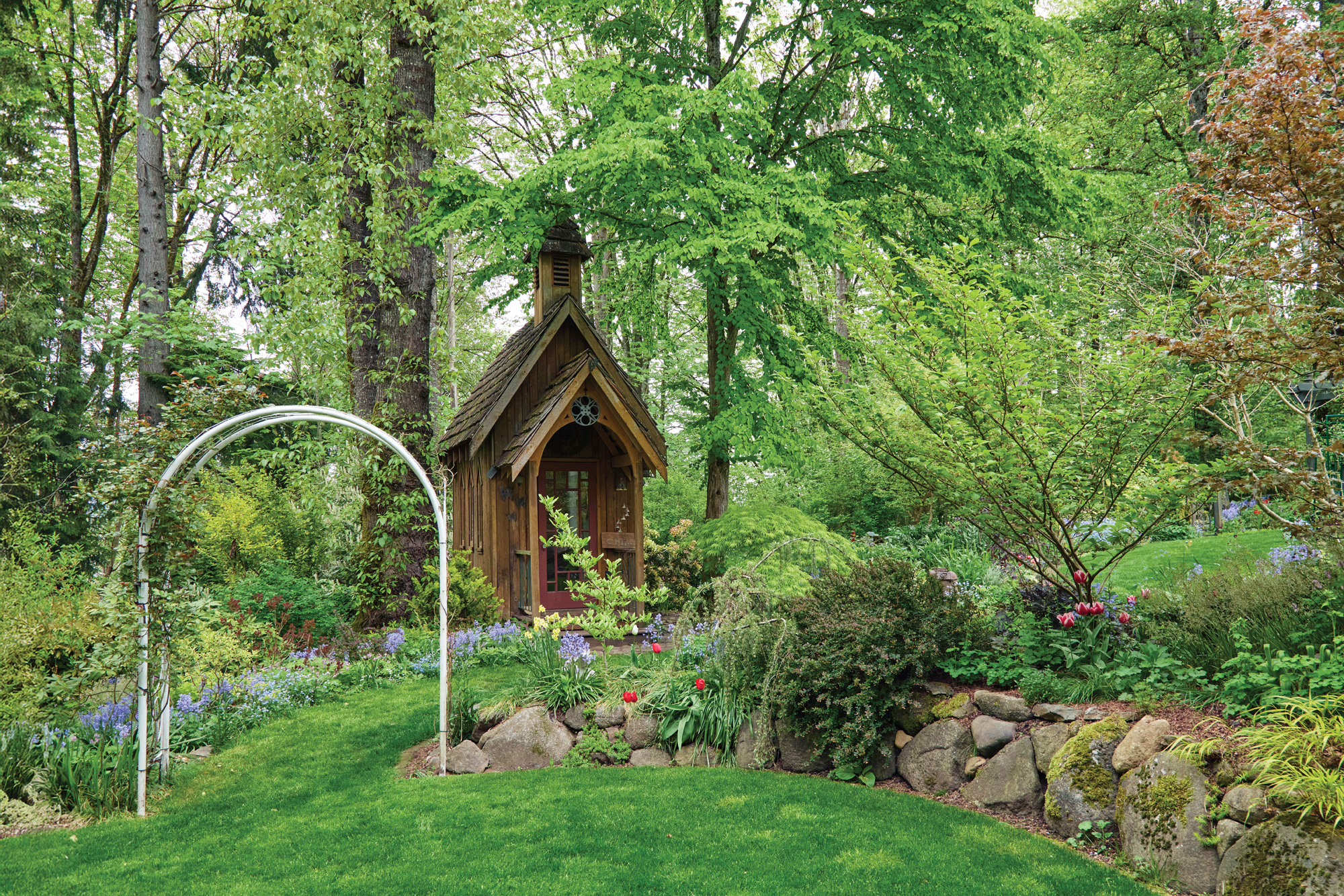
The couple repurposes building materials whenever they can for these structures. For example, Ted utilized rough-sawn telephone pole offcuts to make the chapel’s siding and hand-split roofing shakes for the shed and chapel from a 60-foot cedar tree that had fallen in the ravine and needed to be removed. He worked on the shakes for about six months, and still has a stash ready for another project.
Ted added the cupola on the shed a couple of years ago after he found a stained glass window that he thought deserved to be displayed prominently. After designing the cupola, he and their son modified the shed roof to accommodate the new feature.
You Might Also Like:
How to Create a Sensory Garden
Classic Garden Woodworking Project Plans
Upcycling Project Ideas
Chapel getaway
Nadine and Ted knew that they’d like to nestle a small building into this semicircle of trees, and the tight quarters inspired this Gothic-style chapel. With skills he learned along the way and some coaching from his father-in-law, Ted has built all manner of projects. At 10 by 12 feet, the chapel is just the right size for a small table and chairs, where the grandkids like to play in warmer months. Ted says, “It’s enough for a small congregation: You can get about six people in there. But we do have a choir loft!”

The plant palette
Because there aren’t many full-sun spots on this north-facing slope, Nadine has chosen to grow mostly flowering plants in the garden, although she has found a few pockets in the front yard to grow her favorite vegetables.
Creating year-round garden interest
When choosing plants, her goal is to have interest throughout the year. Nadine says, “It’s been an experiment over the years to find which plants do well here. I move things around quite a bit until I find a spot where they’re happy.”
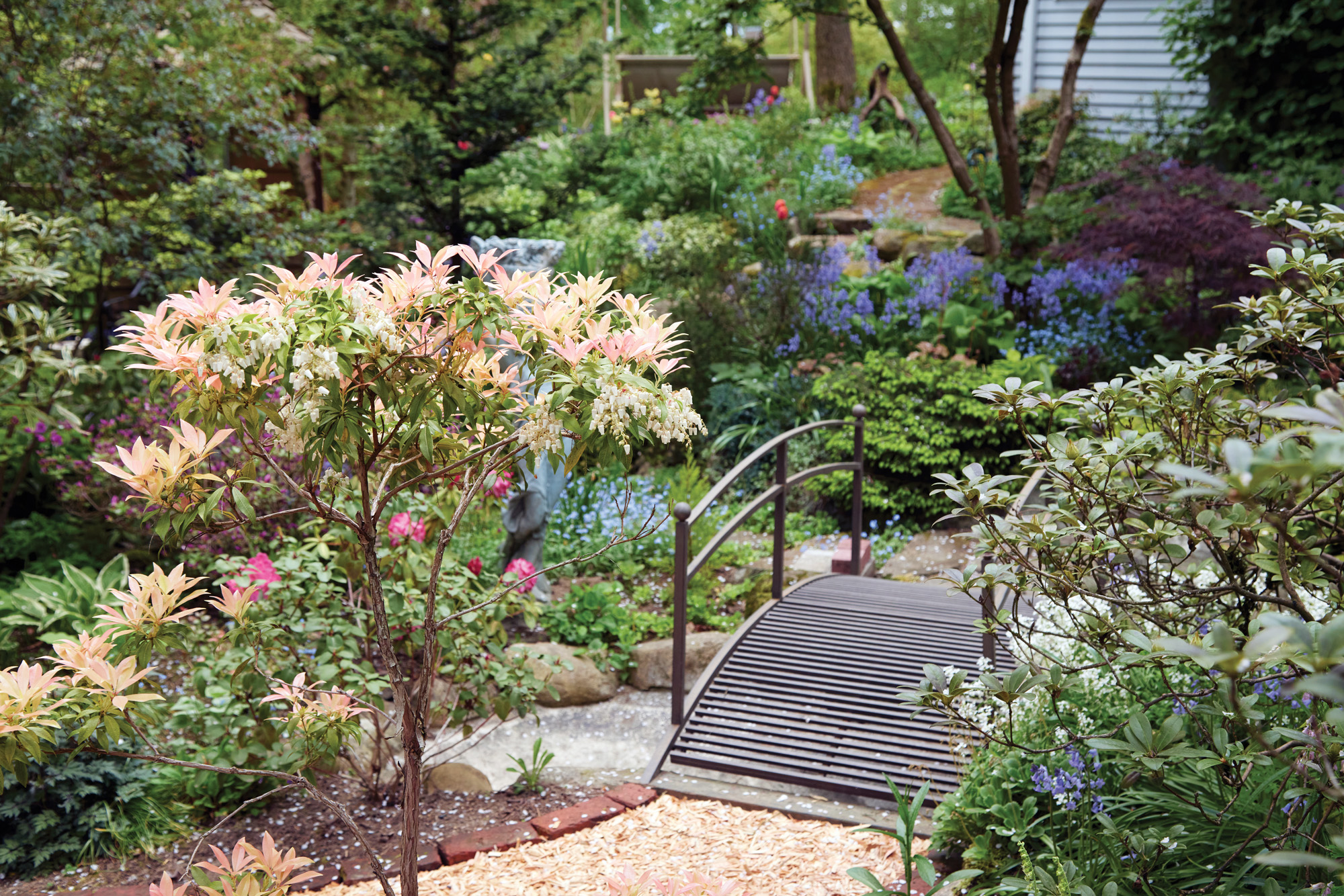
From November through March, fragrant ‘Pink Dawn’ viburnum (Viburnum x bodnantense) in the photo above blooms alongside an early round of witchhazels (Hamamelis spp. and hybrids) and hellebores (Helleborus spp. and hybrids), followed by daffodils (Narcissus spp. and hybrids), snowdrops (Galanthus spp. and hybrids) and crocuses (Crocus spp. and hybrids) in February. Nadine and Ted are big fans of ‘Pink Dawn’ because of its long bloom time, sweet scent and its attractiveness to the Anna’s hummingbirds that remain all winter in their garden.
Add seasonal show-offs
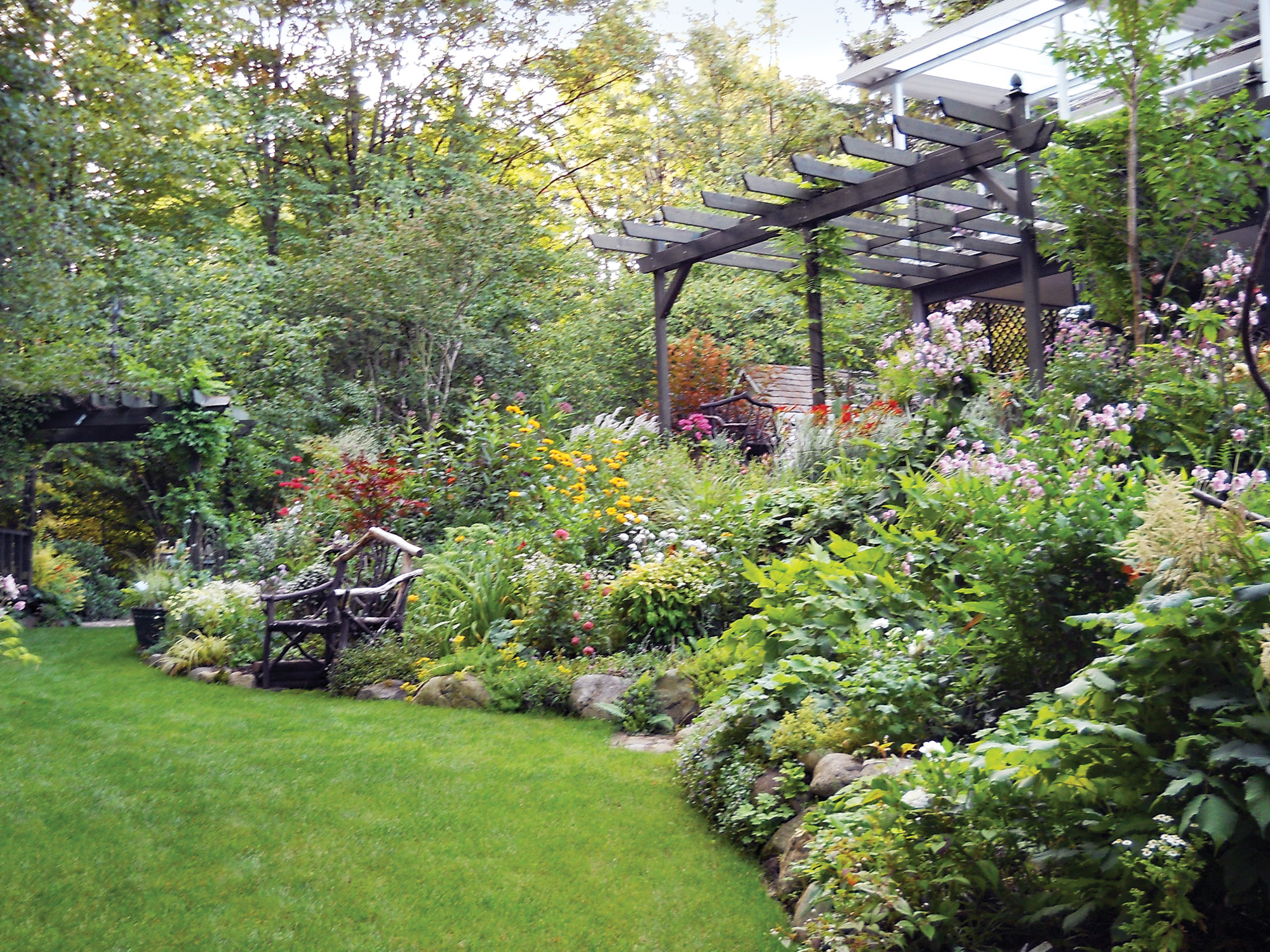
By the middle of spring the rhododendron (Rhododendron spp. and hybrids), euphorbias (Euphorbia spp. and hybrids) and pasque flower have joined the party. Later, summer-blooming perennials such as coreopsis (Coreopsis spp. and hybrids) and black-eyed Susans (Rudbeckia spp. and hybrids) in the photo above start their show, and by fall, the dahlias (Dahlia hybrids) are in their glory.
Finding drought-tolerant plants to deal with weather changes
With less rain in recent summers, the Stauntons have started taking note of which plants are most drought tolerant. Some standouts include hostas (Hosta spp. and hybrids) and rhododendrons, which put on such a beautiful show in spring. So when they’re shopping the nursery sales in fall, their favorite time for bargain plants, they’re including drought tolerance on their list of must-have characteristics. Ted chops up the plentiful leaves that fall on the property, and the couple mulches with them to help retain soil moisture as well.

Get easy repetition with reseeding plants
Repeating pools of blue flowers along the pathways has mostly happened naturally as annuals and perennials reseed around the structural trees and shrubs. Nadine says: “I tend to leave most of them unless they’re in the way or impeding another plant. Because it’s such a large garden I don’t have time to manicure every spot.” Learn more about her favorite reseeding plants here!
You Might Also Like:
Buy the Current Issue of Garden Gate Magazine
Watch Our Videos on YouTube
Travel to Gardens With Us!