TREES you can POLLARD:
- Beech Fagus spp.
- Black locust Robinia pseudoacacia
- Catalpa Catalpa spp.
- Hornbeam Carpinus spp.
- Horsechestnut Aesculus hippocastanum
- Linden Tilia spp.
- London planetree Platanus xacerifolia
- Mulberry Morus spp.
- Redbud Cercis canadensis
- Tree of Heaven Ailanthus altissima
- Willow Salix spp.
, we showed you how to get colorful winter stems on your shrubs by using the age-old pruning style of coppicing. You can do a similar technique, known as pollarding, on trees. It’s a unique look, originally used to grow and harvest firewood without killing the tree. Or in some cities it’s also done to street trees to contain the size of tree. Without pollarding, these trees would grow to be much too large for their location.
What is pollarding? — In a nutshell, pollarding is dramatically cutting back the major limbs of a tree. Each year following that, the long slender shoots that grow below the cuts are removed, and each year a set of new shoots quickly take their place. Eventually a pollarded tree develops a stubby, gnarled appearance. If it’s something you’d like to do, you’ll find a list of trees you can pollard at right. Here’s how pollarding is done:
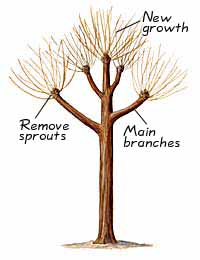
Step one — The first spring. Start by topping the tree. This is not something you’re usually told to do to a tree, but in early spring cut off all of a young tree’s main branches. Leave a scaffolding of stubs like the ones you see in the illustration above. Along the stubs there are lots of dormant buds that you can’t see. When you remove large limbs like this, these buds will be stimulated to grow.
Step two — Later that year. By late spring you’ll see tight groupings of fast-growing, tender new growth sprouting just below the cuts. Occasionally you have a few sprouts lower on the limbs or trunk. Nip those off right away so they don’t spoil the outline of the tree.
Step three — Every spring thereafter. Once you start pollarding, you’ll need to make it a yearly pruning practice. Each spring, all of those new shoots that grew last year will need to be cut off as close to the original cut as possible. If a pollarded tree is not pruned every year, the shoots grow and expand, pushing against each other. Eventually the tree will develop weak crotch angles and moisture will enter the wood. The tree will begin to rot and fall apart.