



Any plant out of place can become a garden enemy.
Here are strategies for fighting the battle against weeds.
When you ask gardeners what their favorite part of gardening is, most will tell you it’s enjoying the beautiful flowers and fresh vegetables. What’s the worst part? Almost everyone agrees it’s weeding. Gardeners are always looking for ways to get rid of weeds. And a good attack plan has two prongs: prevention, such as removing seedheads before they develop or using a a pre-emergent herbicide, and removal, pulling, digging or hoeing out established weeds or using a herbicide to kill them.
Weeds can be divided into roughly two categories — annual and perennial — with the difference being how they reproduce. They each have a different life cycle. Once you know which a weed is, you can determine the best way to control it.
As the old saying goes, “Seeds one year, weeds for seven.” If you can prevent plants from producing seeds, you’ll have fewer to remove in the future. But once they start, there are several ways to get rid of them. The method depends on the weed, its maturity and its situation. Let me show you how to plan the battle against weeds in your garden.
Preventing Weeds | Removing Weeds | Life Cycles of Weeds
Preventing Weeds
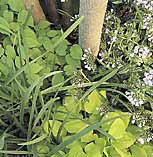 The easiest way to deal with a problem is to prevent it from occurring. All weeds spread by seeds. Some seeds can live for many years in the soil. Every time you till, you bring more of them to the surface where sunlight prompts them to sprout.
Since seeds often need light to sprout, one good way to shade weeds out is with close planting of ornamental plants. Close planting shades the soil so seeds can’t sprout easily. Even many creeping, perennial weeds don’t like the shade and competition — they won’t spread into these areas. Leave enough space between your plants so they just touch, as shown in the photo, and don’t compete with each other.
The easiest way to deal with a problem is to prevent it from occurring. All weeds spread by seeds. Some seeds can live for many years in the soil. Every time you till, you bring more of them to the surface where sunlight prompts them to sprout.
Since seeds often need light to sprout, one good way to shade weeds out is with close planting of ornamental plants. Close planting shades the soil so seeds can’t sprout easily. Even many creeping, perennial weeds don’t like the shade and competition — they won’t spread into these areas. Leave enough space between your plants so they just touch, as shown in the photo, and don’t compete with each other.
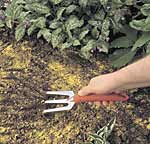 In open areas, such as flower or vegetable gardens, spreading a pre-emergent herbicide helps. After it’s applied, make sure you don’t disturb the barrier or weeds will be back. Corn gluten, the organic pre-emergent control being scratched into the soil in this photo, won’t stop the spread of perennial runners or roots. It’ll last several months depending on the product and weather conditions and releases nitrogen into the soil as it breaks down.
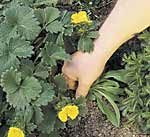 Pulling weeds, as I’m doing in the photo, before they produce seeds is a good way to spend the afternoon. I call it weeding therapy because it’s so satisfying once my garden is spotless and free of pesky weeds. Just make sure to get every piece of root if your pulling perennial weeds or they will regrow.
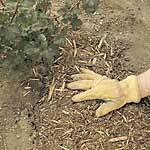 Even putting down a thick layer of mulch like this will prevent weeds. Mulching shades the surface of the soil and keeps weed seeds from germinating. Even if a few seeds do happen to sprout, they can be easily pulled because the soil underneath stays loose. It also helps conserve moisture and keep the soil cooler on hot summer days. To be effective, it needs to be at least two inches thick or have a weed-barrier fabric underneath.
No matter how diligent you are, weed seedlings and sprouts will appear and get established in your garden somehow. That’s when it’s time to begin removing weeds.
Even putting down a thick layer of mulch like this will prevent weeds. Mulching shades the surface of the soil and keeps weed seeds from germinating. Even if a few seeds do happen to sprout, they can be easily pulled because the soil underneath stays loose. It also helps conserve moisture and keep the soil cooler on hot summer days. To be effective, it needs to be at least two inches thick or have a weed-barrier fabric underneath.
No matter how diligent you are, weed seedlings and sprouts will appear and get established in your garden somehow. That’s when it’s time to begin removing weeds.
Removing Weeds
Once a weed has sprouted, you have a few ways of dealing with it. The sooner you catch it, the easier it will be to remove.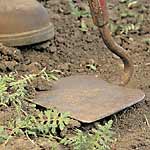 Hoeing is a quick and efficient way to remove tender, young seedlings, especially annuals. It’ll slice them off just below the soil’s surface so they can’t regrow. Working the hoe at the shallow angle used in the photo at right won’t bring many more seeds to the surface, ready to sprout. Notice how the hoe is almost parallel to the soil? Chopping into the soil deeper might expose more weed seeds.
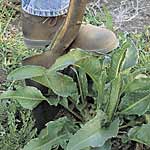 Digging works well for removing large, well-established weeds from the ground. Aim the blade straight into the soil and pry the weed out. Make sure to remove all of the roots of perennial weeds or they might sprout and begin growing again.
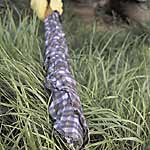 Using herbicides is a better solution for weeds in a lawn or closely planted perennial garden where pulling or digging may not be practical. Make a wick like the one here from a rag wrapped around a stick to put the herbicide just where you want it. You can saturate the rag and carefully brush it over the weed without harming desirable plantings.
Spraying herbicides on seedlings that could be hoed or pulled is probably overkill. On the flipside, once a perennial weed becomes established, cutting off the top or pulling at it might not be enough. Many have deep or extensive root systems.
Using herbicides is a better solution for weeds in a lawn or closely planted perennial garden where pulling or digging may not be practical. Make a wick like the one here from a rag wrapped around a stick to put the herbicide just where you want it. You can saturate the rag and carefully brush it over the weed without harming desirable plantings.
Spraying herbicides on seedlings that could be hoed or pulled is probably overkill. On the flipside, once a perennial weed becomes established, cutting off the top or pulling at it might not be enough. Many have deep or extensive root systems.
Life Cycles of Annual and Perennial Weeds
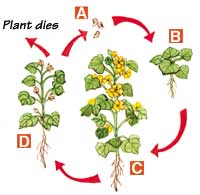
Annuals — In one season, a seed (A) sprouts. The seedling (B) grows to maturity and flowers (C). After it flowers, the seeds ripen (D) and the plant dies. Seeds drop to the ground and the process starts over again when soil conditions are right.
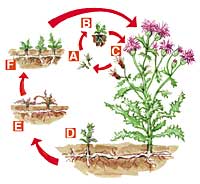
Perennials — Just like annuals, perennials can spread by seed (A, B and C). But roots or runners from the parent plant can also sprout (D). They go dormant in winter (E). The following spring they grow (F), reach maturity, send out more runners and spread more seed.